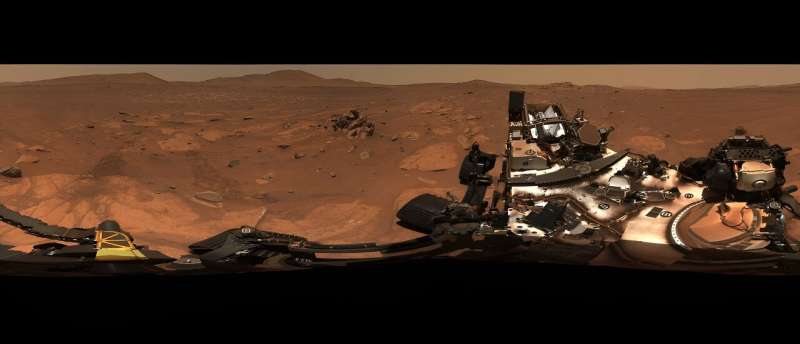
As the Perseverance rover marks its 1,000th day exploring the Red Planet, it has successfully completed its study of the ancient river delta within Jezero Crater, shedding light on the history of the Martian lake that existed billions of years ago. To date, the rover has collected a total of 23 samples, each contributing to our understanding of the geologic history of Mars.
The “Lefroy Bay” sample is rich in fine-grained silica, which is known to preserve ancient fossils on Earth. Similarly, the “Otis Peak” sample contains a significant amount of phosphate, a substance often associated with life as we know it. Both samples are abundant in carbonate, which holds a valuable record of the environmental conditions in which the rock was formed.
This exciting discovery was shared on Tuesday, Dec. 12, at the American Geophysical Union fall meeting in San Francisco.
Ken Farley, Caltech’s Perseverance project scientist, spoke about the decision to select Jezero Crater as a landing site: “We picked Jezero Crater as a landing site because orbital imagery showed a delta—clear evidence that a large lake once filled the crater. A lake is a potentially habitable environment, and delta rocks are a great environment for entombing signs of ancient life as fossils in the geologic record. After thorough exploration, we’ve pieced together the crater’s geologic history, charting its lake and river phase from beginning to end.”
Jezero, formed from an asteroid impact almost 4 billion years ago, contains a floor made of igneous rock, alongside sandstone and mudstone. The presence of salt-rich mudstones also suggests the existence of a shallow lake that eventually covered 22 miles in diameter and up to 100 feet in depth.
In later stages, fast-flowing water carried in boulders from outside Jezero, depositing them atop the delta and throughout the crater.
Libby Ives, a postdoctoral fellow at NASA’s Jet Propulsion Laboratory, was excited about these findings: “We were able to see a broad outline of these chapters in Jezero’s history in orbital images, but it required getting up close with Perseverance to really understand the timeline in detail.”
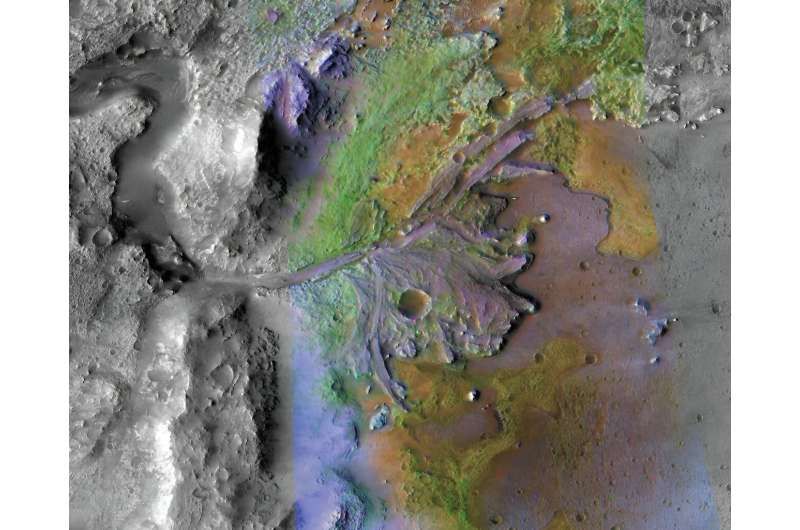
This image of Mars’ Jezero Crater is overlaid with mineral data detected from orbit. The green color represents carbonates – minerals that form in watery environments with conditions that might be favorable for preserving signs of ancient life. [Read More](https://phys.org/news/2023-12-nasa-perseverance-rover-deciphers-ancient.html)
