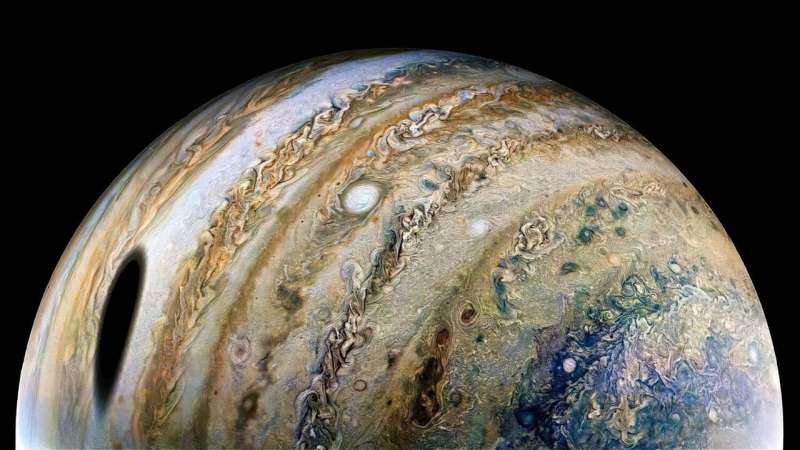
In an unprecedented moment, an instrument designed to discover planets light years away was used to study the winds of Jupiter.
The discovery of planets orbiting other stars has become increasingly common, with over 5,000 already identified. However, the focus of previous discoveries has been mainly on giant planets. This new observation technique now provides a unique opportunity to delve deeper into Jupiter and expand our understanding of distant worlds.
Prior to this study, most of our data on exoplanet atmospheres was highly limited. Meanwhile, many questions about Jupiter’s atmosphere remained unanswered due to the lack of thorough continuous observations.
For the first time, researchers utilized an instrument specifically designed to discover and analyze exoplanets to investigate an object much closer to home: Jupiter. Specifically, the team from the Institute of Astrophysics and Space Sciences (IA) at the Faculty of Sciences of the University of Lisbon (Portugal) used the ESPRESSO spectrograph installed on the VLT telescope at the European Southern Observatory (ESO) to measure the wind speeds on Jupiter. The study results have been published in the journal Universe. For more information, you can read the detailed results here.
The innovative methodology, known as Doppler velocimetry, relies on the reflection of visible light from the sun by clouds in Jupiter’s atmosphere. This reflected light is bent in wavelength in proportion to the speed of the clouds’ movement relative to the telescope on Earth, allowing researchers to accurately measure the instantaneous wind speed at the observed point.
This technique, originally developed to study the atmosphere of Venus, represents the groundbreaking work of the Planetary Systems research group of IA. The researchers have been at the forefront of studying the wind dynamics of Venus and have contributed significantly to the general understanding of its atmosphere.
This initial success of applying the methodology to Jupiter using ESPRESSO has paved the way for further exploration and expanded the frontiers of our knowledge about our solar system. The potential for systematically monitoring the atmospheres of remote gaseous planets has been firmly established.
For a period of five hours in July 2019, the team focused the VLT telescope on different regions of Jupiter, providing invaluable insights into its atmospheric dynamics and enhancing our understanding of this fascinating celestial body. To gain deeper insights into the study, you can access the full details here. For more exciting discoveries and updates, be sure to read more.
