Experience All Things America, from Cultural Traditions to Historical Sites
Every year, on the 4th Thursday in November, Americans celebrate Thanksgiving. It’s a commemoration of the 1621 harvest feast when the colonists, who came from England, shared a meal with the land’s Indigenous people.
In Plymouth, Massachusetts, the site of the first Thanksgiving, historians and others work to separate fact from fiction surrounding the legend that grew out of that initial celebratory feast that took place more than 400 years ago.
“The problem with it is that there are so many stereotypes and so much misinformation that’s bundled into that story,” says Paula Peters, a member of the Mashpee Wampanoag Tribe. “It’s a story that really marginalizes the Wampanoag history.”
The pilgrims arrived on the Mayflower in 1620. By their second winter, they were struggling, until the Indigenous people taught them how to plant crops and live off the land.
“When we think of the pilgrims coming over, we ignore the aspect of the Wampanoag people helping them survive that winter, or even navigate this land, or navigate the waters, which is very important,” says Wampanoag Tribe member Malissa Costa, who oversees the Native American-themed exhibition at the Plimoth Patuxet Museums.
The living history museum, located a few miles from the site of the first Thanksgiving, also features a 17th-century English village. Actors dress up as pilgrims to portray the colonists’ way of life, while Thanksgiving traditions are recreated for visitors.
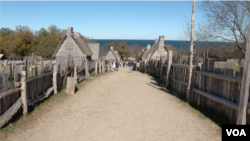
“What the pilgrims are celebrating is really that they are going to have food. They are not going to starve in the coming year,” says Malka Benjamin, director for colonial interpretation and training at the Plimoth Patuxet Museums. “And so, visitors are going to be able to help with cooking preparations for the event. They may get pulled into a game, a sport … there’s going to be musket shooting demonstrations.”
It was the sounds of guns going off that prompted Native Americans to investigate, which is how her Wampanoag ancestors arrived at the first Thanksgiving, according to Peters.
“At some point, they decided, ‘Oh, this isn’t a threat. They’re just celebrating their harvest.’ And guess what? We’re all here now, so, we’re all going to eat,” says Peters, who used to work at the Plimouth Patuxet Museums.
That part of the story is challenged by Peters’ former colleague, Richard Pickering, chief historian at the living history museum, who says that theory was discussed, but then discarded by the museum.
The contrasting perspectives highlight the fact that no one really knows exactly what happened at the first Thanksgiving. There are almost no direct accounts of the event,
