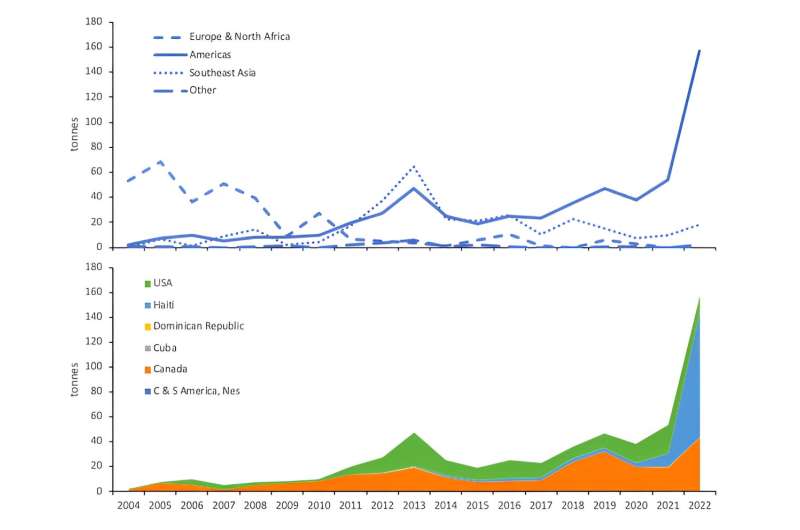
(Top) Imports of live eel fry into East Asia from the other areas based upon East Asian Customs information, 2004– 2022. (Bottom) Imports of live eel fry into East Asia from the Americas based upon East Asian Customs information, 2004– 2022. Credit: Hiromi Shiraishi
Hiromi Shiraishi, a scientist at Chuo University, led a research study showing a significant increase in the importation of American Eel (Anguilla rostrata) live fry to East Asia for aquaculture purposes. This rise poses a potential threat to the already endangered species, further depleting the resources of this species.
“Early warning of an upswing in global trade in the American Eel,” has been published in Marine Policy.
Japan relies on imports for two-thirds of its eel consumption, and a substantial amount of American Eel is believed to be included in these imports. As a major consumer of eels, Japan is urged to take a leading role in ensuring the sustainable use of eel species, including the American Eel.
There are currently 19 species/subspecies of freshwater eels in the genus Anguilla. Eels are vulnerable to a range of threats including changes in oceanic currents and/or weather conditions, barriers to migration, loss or destruction of freshwater habitat, disease, pollution, and unsustainable exploitation and trade.
Stocks of eel species, most notably those in temperate Northern Hemisphere regions, have shown declines. These include the European Eel, currently listed as Critically Endangered (CR) on the IUCN Red List of Threatened Species, as well as the Japanese Eel and American Eel, which are categorized as Endangered (EN).
As artificial breeding of Anguilla spp. is not yet commercially feasible, most consumed eels originate from wild eel fry (glass eels) that are captured and then farmed. Live eel fry have become targets for capture in many countries as crucial ‘seeds’ in farming/aquaculture operations. Eel farming mainly takes place in East Asia (China, Japan, South Korea, and Taiwan), with Hong Kong being an important trade center.
With the European Eel being listed CITES Appendix II in 2007, which entered into effect in 2009, and the low catches of Japanese eels in the early 2010s, fishing and trade of live fry of other eel species has increased. Imports from the Americas into East Asia remain high, while Haiti and the Dominican Republic appear to have become important exporters of live eel fry recently.
Customs import data for Anguilla live eel fry for the East Asian countries and regions provide an overview of trade dynamics of live eel fry imported into the region. As species-specific Customs data are not available, geographical origin and the IUCN Red List were used to presume the likely eel species being traded and delivered to farms (e.g., assuming imports from Canada to be American Eel).
It is noted that while all East Asian countries/territories have import codes for live eel fry for aquaculture, the definitions vary, potentially including larger size of eel fry in the data.
