- News
- Science & & Astronomy
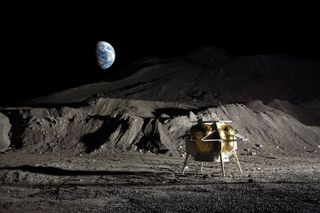
Artist’s illustration of Astrobotic’s Peregrine lander on the surface area of the moon. (Image credit: Astrobotic)
Early on Christmas Eve morning, while the presents are still unwrapped and the smell of gingerbread fills the air, a spacecraft is set to venture to the moon.
It’s named the Peregrine Lunar Lander, after the fastest flying bird in the world. If all goes according to plan, the robotic bird will soar through space, flying into the moon’s gravitational tides, then carefully lower its orbit until eventually touching down on a region of ancient lunar lava streams known as the Bay of Stickiness, or Sinus Viscositatis.
This mission will be one for the history books for several reasons, one of which is the fact it’ll be the first launch under NASA’s Commercial Lunar Payload Services (CLPS) effort, developed as a way for the agency to bring payloads to the moon without having to build all the spacecraft needed to transport those payloads there. In this case, the company Astrobotic is behind the Peregrine lander and NASA’s paying to stow away a few things onboard.
Related: Spiders on the Moon: ‘Walking’ Robots Will Explore Lunar Crevices and Caves
As for the rocket, there’s another first to talk about. Peregrine will be taking off on the first flight of United Launch Alliance’s Vulcan Centaur rocket. The successor to the company’s Atlas V and Delta IV vehicles, Vulcan Centaur is, among other things, built to carry quite a significant amount of items to space.
And during a briefing on November 29, representatives with Astrobotic, United Launch Alliance and, of course, NASA, gathered to discuss what some of the Peregrine payloads are going to be as well as lay out how everything is expected to go down the day before Christmas.
What’s heading to the moon?
There are 5 total NASA-sponsored payloads heading to the lunar surface during the mission, and the first is called the “Peregrine ion trap mass spectrometer,” or PITMS.
PITMS will be analyzing the lunar exosphere, which is a thin gaseous envelope around the moon, by using mass spectrometry. Mass spectrometry simply refers to the method scientists use to measure the mass-to-charge ratio of ions, which are charged particles like hydrogen atoms that hold a positive proton, but no negative electron to balance the proton out.
“The science comes from PITMS will aim to enhance our understanding of the abundance and behavior of volatiles on the moon and how they respond to perturbations such as rocket exhaust,” Ryan Watkins, program scientist at NASA’s Exploration Science Strategy and Integration Office, said.
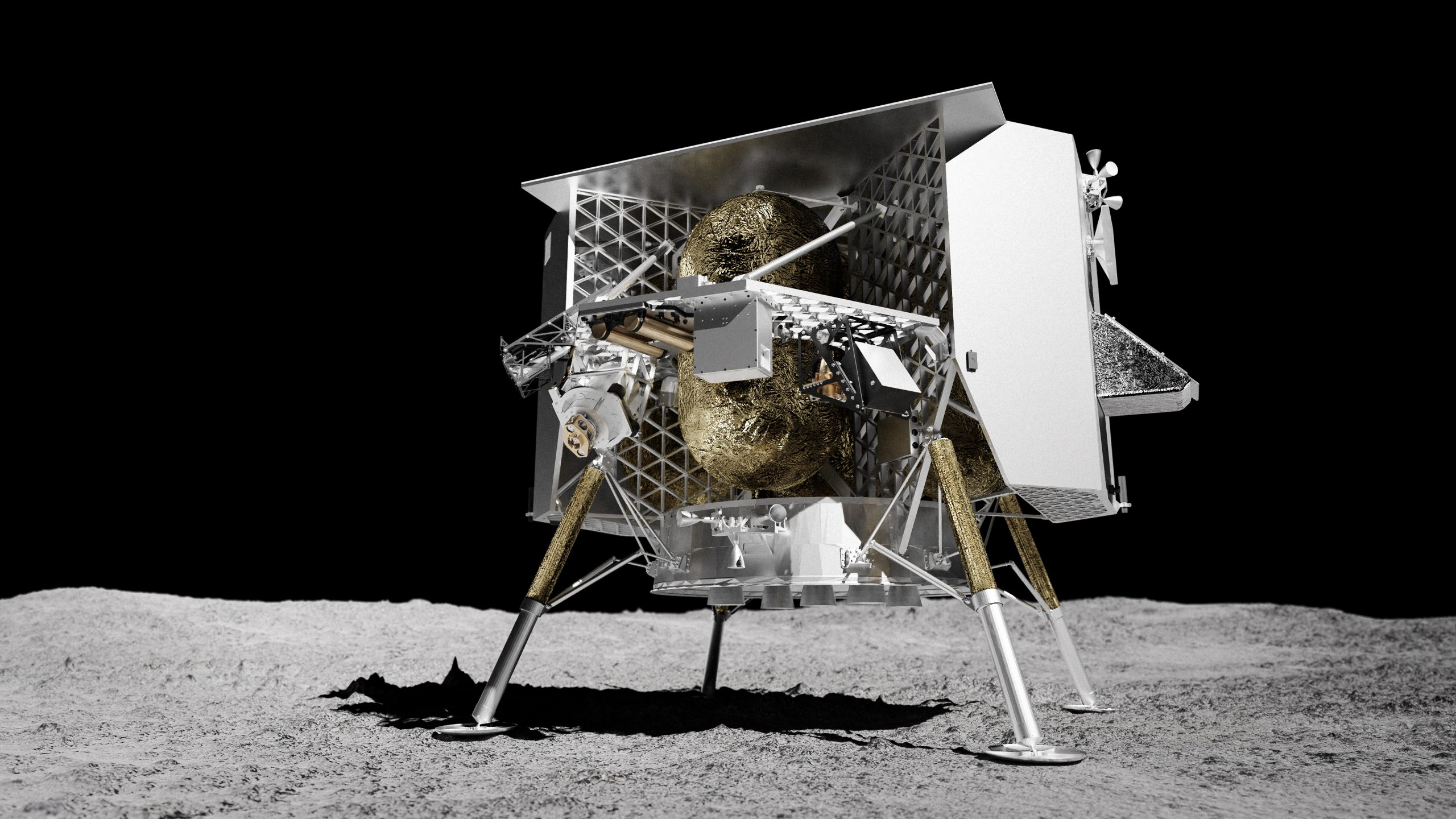
Render of Peregrine on the lunar surface area. (Image credit: Astrobiotic)
Peregrine will also be bringing a neutron spectrometer system, or NSS, Watkins explained, which will measure the amount of neutrons near the lunar surface as well as their associated energies.
