Credit: Pixabay/CC0 Public Domain
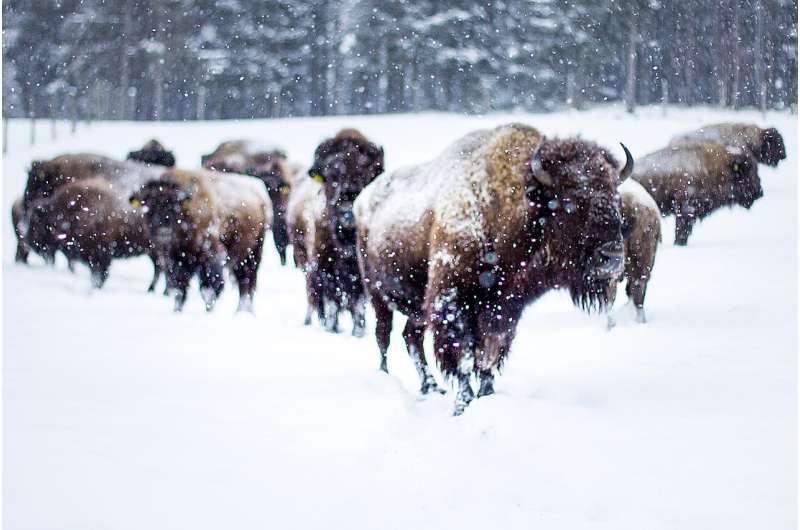
A herd of 250 bison were brought into the Rocky Mountain Arsenal National Wildlife Refuge to help restore the toxic wasteland to its native short-grass prairie. Frequently, the bison will tromp down to the First Creek floodplain to cross into the northern half of the refuge.
However, the gushing waters from the rapidly urbanizing areas of Denver and Aurora have carved a gully that blocks the bison’s path.
“This is a human-created challenge because of all the development,” biologist Sarah Metzer, the refuge’s supervisory ranger, explained. “While bison are nimble, crossing the gully will be difficult for them.”
The deepening gully is a challenge for the bison herd’s recovery and the larger mission of revitalizing the land. This area was previously used by the U.S. Army to produce chemical weapons and by the Shell Oil Co. to produce DDT.
“The bison won’t graze on the land across First Creek because now they have to go all the way around,” Metzer said. “That land is not going to get grazed. All the ecological benefits of having bison here are for naught.”
Federal wildlife biologists managing the refuge have a plan to rebuild the floodplain, starting in January, with estimated costs between $40 million and $61 million. They also aim to address more pressures that will result from continued growth around the refuge and a warming climate.
It must be “restoration on steroids,” refuge manager David Lucas said.
Runoff has increased gradually over three decades due to the development east of metro Denver, impacting the water flows in the area.
The floodplain reconstruction calls for re-contouring land and creating a curving creek, extending the length from 5.3 miles to 7.7 miles. The new floodplain is expected to carry more water toward the South Platte River.
Federal biologists have used bison, herbicides, and prescribed fire to restore the prairie. The bison, introduced in 2006, have thrived, with some bulls weighing more than a ton. Until now, the toughest challenge for refuge managers has been crowd control as people flock to see the bison. Visitations this past year exceeded 950,000, shattering previous records.
However, providing enough grazing habitat for the bison to sustain, let alone grow, is challenging.
Lucas recently began training to operate large yellow earth-moving machines himself to address the issue.
