 inaccurate information. Credit: SUTD” width=”800″ height=”529″/>
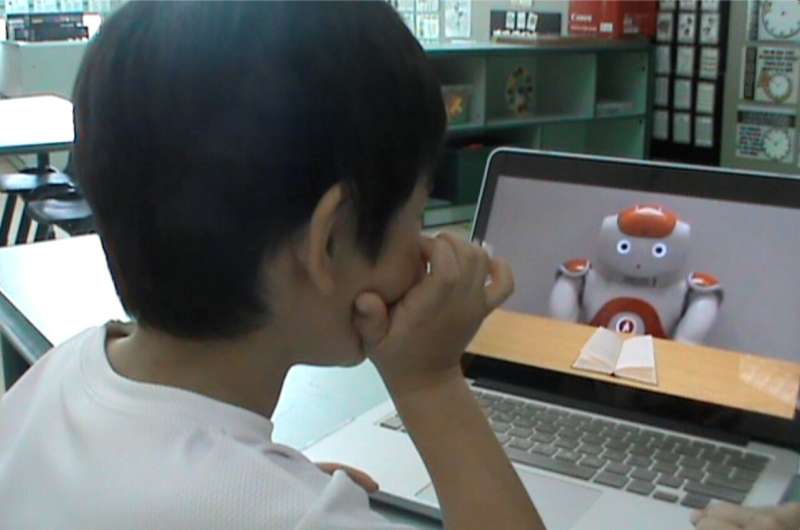
A child watching a robot provide accurate or inaccurate information. Credit: SUTD
In today’s digital age, children are bombarded with a wealth of information online, much of which is unverified and increasingly produced by non-human sources, such as AI-driven language models. As children grow older, the capacity to evaluate the reliability of a source is a crucial skill in developing critical thinking.
According to a study published in the journal Child Development titled, “Younger, not older, children trust an inaccurate human informant more than an inaccurate robot informant,” children aged 3 to 5 years show selective trust based on the informant’s past accuracy when encountering both humans and robots.
“Children don’t just trust anyone to teach them labels, they trust those who were reliable in the past. We believe that this selectivity in social learning reflects young children‘s emerging understanding of what makes a good (reliable) source of information,” explained Li Xiaoqian, a research scholar at Singapore University of Technology and Design (SUTD) who co-authored the study. “The question at stake is how young children use their intelligence to decide when to learn and whom to trust.”
In the study, participants from Singapore preschools such as ChildFirst, Red SchoolHouse and Safari House, aged between 3 and 5, were split below and above the median age of 4.58 years old into “younger” and “older” cohorts, respectively.
They were paired with a robot or human informant, which either provided accurate or inaccurate labels to objects, such as “ball” or “book.” The researchers then tested to see if the informant’s identity (human or robot) and track record as a reliable informant as well as the child’s age influenced the child’s trust in the informant to label things correctly in the future.
Participants were presented with only one informant during the study, and their trust was measured by their willingness to accept new information. The humanoid social robot by SoftBank Robotics, NAO, which has a human-like but robotic voice, was used as the robot informant.
To keep conditions comparable, the human informant matched her movements to those of the robot. An experimenter was also seated next to the participant to ask the necessary questions, so that the participant would not feel pressured to agree with the informant.
The study revealed that children were willing to accept new information from both human and robot informants who had previously given accurate information, but not from a potentially unreliable informant who had made mistakes in the past—especially when the informant was a robot. As for the age effect, the authors reported that younger children were likelier to accept information from an unreliable human than an unreliable robot, but older children were found to distrust or reject information from an unreliable informant, human or robot.
“These results suggest that younger and older children may have different selective trust strategies,
