Out in the wind
By Dhananjay Khadilkar | Dec 21, 2023 4:51 pm UTC
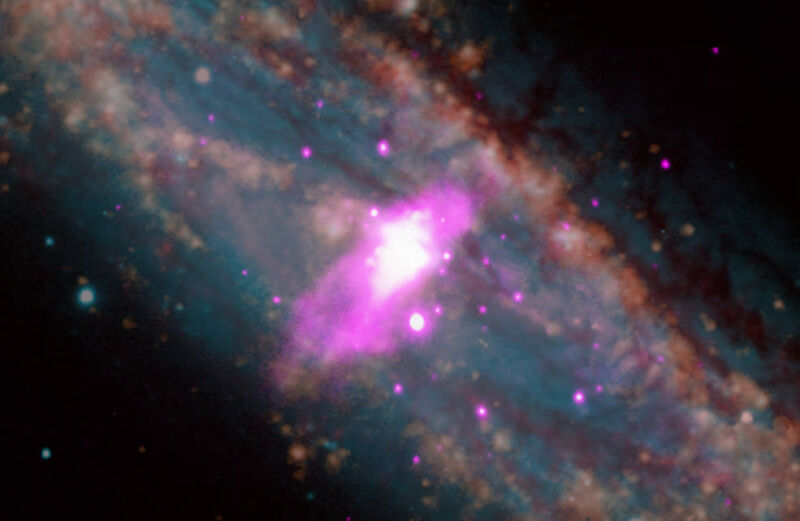
Enlarge / X-ray emissions (purple) superimposed on a visible light image of a galaxy shows the galaxy winds being launched.
CREDIT: X-ray: NASA/CXC/Ohio StateH-alpha and Optical: NSF/NOIRLab/AURA/KPNO/CTIO; Infrared: NASA/JPL-Caltech/Spitzer/ Optical: ESO/La Silla Observatory.
Massive stars can drive gas out of galaxies, shaping their future evolution.
One of the ways massive stars, those at least 10-times bigger than the Sun, reach their end is in a supernova—an enormous explosion caused by the star’s core running out of fuel. One consequence of a supernova is the production of galactic winds, which play a key role in regulating star formation. A team of scientists has now made the first direct observations of this phenomenon in a large population of galaxies in the distant Universe, at a time when galaxies are in their early stages of formation.
According to the study’s lead author, Yucheng Guo, of the Centre de Recherche Astrophysique de Lyon, galactic winds are an important part of the galaxy evolution models.
“It was assumed there should be galactic winds that can regulate galaxies’ growth. However, it was very difficult to directly observe these winds. With our study, we show that at the early stage of the Universe, every normal galaxy had such winds,” Guo said.
According to Guo, galactic winds form a key part of the so-called feedback process that is important in our understanding of galaxy evolution. “Galactic winds originate as a result of star formation activity. These winds inject a lot of energy and momentum into the gas, resulting in it [being] expelled from the galaxy. If there is not enough gas in the galaxy, the star formation stops. This is called the feedback process,” he said.
According to Guo, galactic winds also enable exchange of matter between galaxies and their surroundings. “Each galaxy is surrounded by a gas halo. Galaxies can breathe out as well as breathe in gas,” Guo said.
He said that traditionally it has been very difficult to observe galactic winds, because the gas halos are almost transparent.
Guo and his team overcame this hurdle by using the Multi-Unit Spectroscopic Explorer (MUSE) instrument on the Very Large Telescope. “The instrument is able to observe the galaxies at redshift z ≈ 1, which corresponds to 7 billion years of the cosmic evolution.” Guo said at that wavelength, the MUSE instrument is able to detect and directly observe the emission from magnesium atoms in the galactic winds.
He said the other important feature of the research is that they managed to observe the galactic winds in more than 100 galaxies. “We also managed to detect the average shape of these winds, which is like an ice cream cone,” he said.
Guo said the direct observation of the galactic winds outside the local Universe was the first step of their research.