Frogs are famous for their characteristic tongue, warts, and colorful, poisonous skin. A type of frog in Southeast Asia has a unique feature: fangs. The recently discovered Limnonectes phyllofolia uses its bony jaws to fight with other frogs and hunt prey like giant centipedes and crabs. The species is also the world’s smallest fanged frog, as detailed in a research published in the journal PLOS ONE.
[Related: Female frogs appear to play dead to avoid mating.]
“This new species is tiny compared to other fanged frogs on the island where it was found, about the size of a quarter,” said study co-author Jeff Frederick. “Many frogs in this genus are giant, weighing up to two pounds. At the large end, this new species weighs about the same as a dime” (source).
The frogs were found on the mountainous island of Sulawesi in Indonesia, which boasts a mix of diverse habitats like volcanoes, mountains, lowland rainforest, and cloud forests.
“The presence of all these different habitats mean that the magnitude of biodiversity across many plants and animals we find there is unreal—rivaling places like the Amazon,” said Frederick.
An international research team discovered frog eggs on the leaves of tree saplings and moss-covered boulders in the jungle, which was surprising.
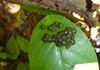 A clutch of Limnonectes phyllofolia eggs laid on a leaf. CREDIT: Sean Reilly
Frogs typically lay eggs covered by a jelly-like substance instead of a hard protective shell, and to prevent them from drying out, most amphibians will lay their eggs in water. This species, however, left their egg masses on leaves and mossy boulders above the ground. After finding these nests, the team began to see the small, brown frogs.
“Normally when we’re looking for frogs, we’re scanning the margins of stream banks or wading through streams to spot them directly in the water,” said Frederick. “After repeatedly monitoring the nests though, the team started to find attending frogs sitting on leaves hugging their little nests.”
Keeping the eggs moist and safe from bacterial and fungal contamination is important, and these frogs were named Limnonectes phyllofolia, which translates to “leaf-nester.”
[Related: Go (virtually) adopt an axolotl, the ‘Peter Pan’ of amphibians.]
The frogs who laid these eggs on leaves and boulders were tiny members of the fanged frog family, and the caretakers of the nests were all males.
