The media industry has been rocked this holiday season by news of newsroom layoffs as outlets downsize to combat volatility in advertising, after an already-brutal year of job cuts.
In the last month alone, Condé Nast, G/O Media, Vice Media and Vox Media have all cut staff, most of whom already had layoffs earlier this year.
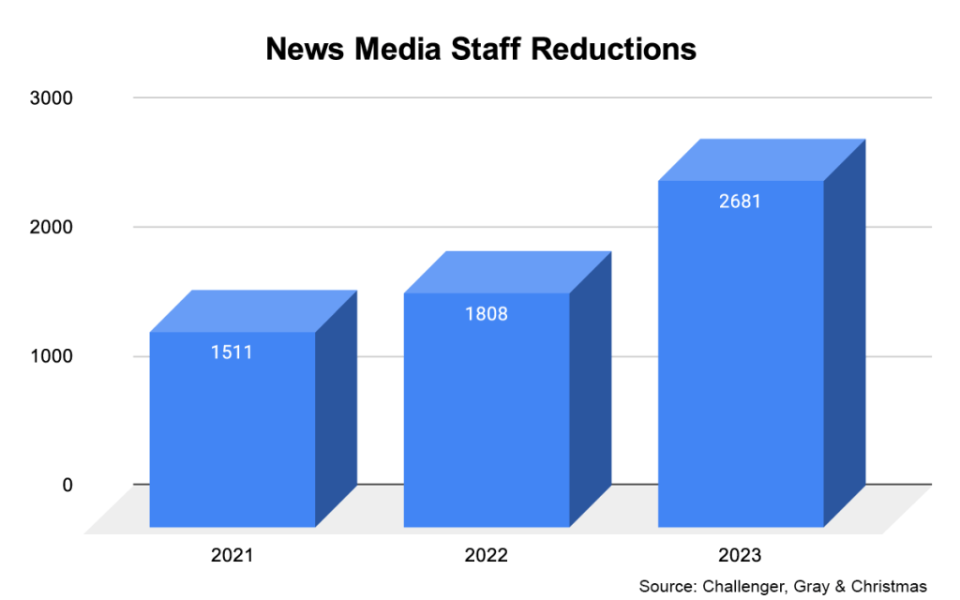
Broadcast, print and digital outlets collectively saw 2,681 journalism job cuts in 2023, up 48% from 1,808 in 2022 and 77% from 1,511 in 2021, according to a report from employment firm Challenger, Gray & Christmas.
With a collapsing advertising-revenue model and more media companies experimenting with artificial intelligence to create content, the outlook for journalism is dimming, media analysts told TheWrap. The decline underscores the need for the public and even governments to fund news gathering if it is to survive in its current form and avoid widespread “news deserts,” they said.
“All available evidence suggests that the commercial future for journalism is especially dire,” Victor Pickard, a professor of media policy and political economy at the University of Pennsylvania’s Annenberg School for Communication, told TheWrap. “We cannot simply let the market drive local journalism into the ground. I expect to see more legislative efforts, especially at state government levels, aimed at shoring up and even expanding local journalism.”
To that end, one bright spot amid the gloomy outlook has been the growth of nonprofit newsrooms, which increased in number by 17% in 2022 and boosted revenues 19% to nearly $500 million between 2021 and 2022, according to a report published this May. Last week, Mother Jones and the Center for Investigative Reporting, two San Francisco based non-profit investigative organizations,said they were merging and would employ 70 staffers.
“Community-based online media, and nonprofit media more broadly, have been relatively insulated from the layoff march,” Jesse Holcomb, an assistant professor of journalism and communication at Calvin University, told TheWrap. “Those newsrooms are often small, lean, and increasingly revenue diverse.”
Heading into 2024, legacy media, which rely on digital and print advertising, are facing tough decisions about whether to cut staff or sell off unprofitable assets.
In November, G/O Media shuttered female-forward publication Jezebel after failing to find a buyer for the outlet, citing a lack of advertising traction for the site. The company laid off 23 editorial staffers, with Gizmodo and The Onion also impacted.
