Archaeologists have made an astonishing discovery of ancient Native American rock carvings at a site on the border between Colorado and Utah. The incredible artworks were created by the Ancestral Puebloans, a Native American culture with a history dating back over 3,000 years.
These ancient Puebloans inhabited what is now southeastern Utah, northeastern Arizona, northwestern New Mexico, and southwestern Colorado. The region is still home to the descendants of this culture and is filled with numerous ancient Pueblo settlements and rock art sites.
Radosław Palonka from the Institute of Archaeology at the Jagiellonian University in Poland, who has been investigating historic Pueblo sites for more than a dozen years, referred to the agricultural Pueblo communities as developing one of the most advanced Pre-Columbian cultures in North America.
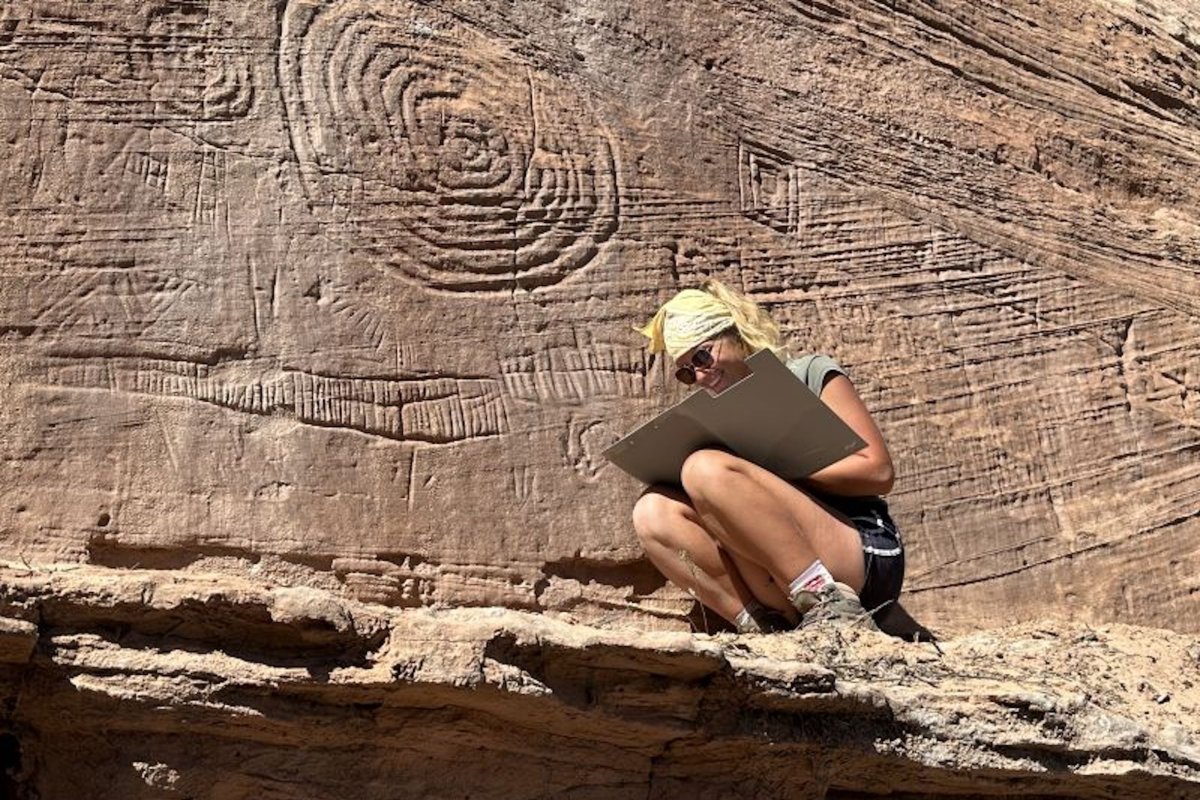
An archaeologist beside the ancient rock art near the Colorado-Utah border. Among the artworks are spiral shapes measuring up to around 3 feet in diameter.
Jagiellonian University
Palonka and colleagues have been conducting research in the area of an ancient settlement complex known as Castle Rock Pueblo, located on the picturesque Mesa Verde plateau on the border between Colorado and Utah.
During their investigations, the archaeologists identified numerous previously unknown petroglyphs—or rock carvings—on huge rock panels stretching more than two-and-a-half miles around the large plateau.
Among the petroglyphs are spiral shapes measuring up to around 3 feet in diameter, which the Puebloans likely used for astronomical observations and to determine the dates of special days in the calendar, such as the spring and autumn equinoxes.
“Our findings from the current year completely change our perception of this settlement area in many different aspects,” Palonka said. “Definitely we have underestimated the number of inhabitants who lived here in the 13th century and the complexity of their religious practices.” » …
Read More rnrn
